Tell us about the job
Takes about a minute. No obligation.
A boiler repair in Durham County starts with a contractor working out what the system has already been through. 143 severe weather events were recorded in Durham County, North Carolina between 2015 and 2024. At that rate, severe weather is a standing feature of operating conditions here, and the stress it puts on heat exchangers, expansion tanks, and pressure relief valves shows up as wear a contractor has to account for before settling on a cause. A part that looks undersized or poorly installed may have simply been carrying a heavier load than the original install anticipated.
Boilers running in older Durham County homes carry a repair history the house itself does not explain. Half the homes in Durham County, North Carolina were built in 1993 or earlier (2020-2024 ACS 5-year). A system installed years after a house was built picks up its own wear pattern, and what a contractor finds once the boiler is open reflects the equipment's own service life: sediment in the heat exchanger, corroded fittings, seals that have cycled past their range. Parts availability for systems of that vintage varies by manufacturer and model, so a contractor opening the unit has to confirm what the system actually takes before quoting the repair.
The Parts of a Boiler a Contractor Checks First
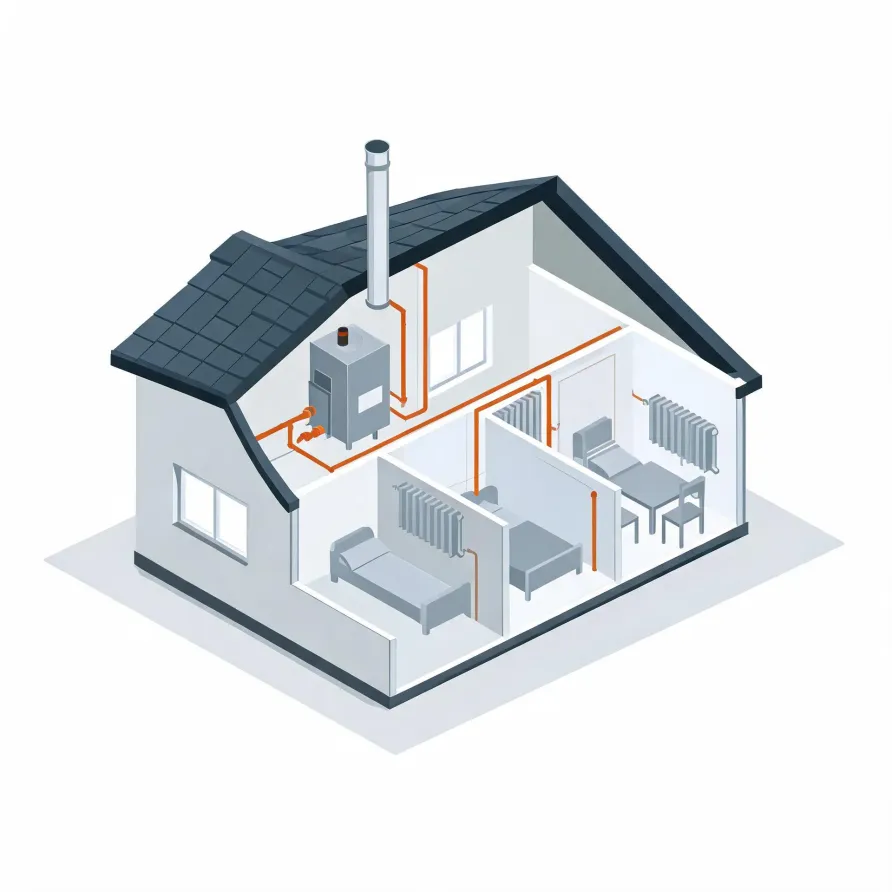
The boiler itself sits in the basement or a utility room and is the piece a contractor goes to first. It heats water and pushes it through the system. When it fails, the signs range from no heat at all to uneven warmth across rooms. The burner, heat exchanger, and pressure relief valve all live inside or directly on that unit.
Radiators or baseboard convectors sit in the living spaces and are what the homeowner feels directly. Connecting them to the boiler are supply and return pipes that run through walls and floors. The circulator pump, which moves hot water through those pipes, and the expansion tank, which manages pressure, are the other pieces a contractor checks when the boiler itself is not the source of the problem.
The drawing shows a typical boiler layout, and a licensed contractor determines which components apply and what condition they are in for this particular house.
Find a contractor in Durham CountyDurham County, by the numbers
143 severe weather events were recorded in Durham County, North Carolina between 2015 and 2024.
NOAA National Centers for Environmental Information, Storm Events Database, bulk CSV export, events 2015-01-01 through 2024-12-31.Half the homes in Durham County, North Carolina were built in 1993 or earlier (2020-2024 ACS 5-year).
U.S. Census Bureau, 2020-2024 American Community Survey 5-Year EstimatesDurham County, North Carolina holds 153,022 housing units (2020-2024 ACS 5-year).
U.S. Census Bureau, 2020-2024 American Community Survey 5-Year EstimatesOwners occupy 55.5% of the occupied homes in Durham County, North Carolina (2020-2024 ACS 5-year).
U.S. Census Bureau, 2020-2024 American Community Survey 5-Year EstimatesBoiler Repair Rules & Standards for Durham County, North Carolina2 sourced regulations and codes
Licensing and Legal Requirements in Durham County, North Carolina
North Carolina issues Class I heating licenses covering all systems in all structures, and Class II licenses covering heating systems in single-family detached residential dwellings.
North Carolina requires a license before any person or firm may engage in, or offer to engage in, the business of heating contracting.
Weather Stress on Boilers in Durham County
Extreme weather events put real load on heating equipment. In Durham County, what happens outside directly affects how hard a boiler works and how often it needs attention.
143 severe weather events, 2015–2024. Source: NOAA National Centers for Environmental Information, Storm Events Database.