Tell us about the job
Takes about a minute. No obligation.
A contractor called to repair a boiler in Halifax County has to account for what the system has already been working against. 107 severe weather events were recorded in Halifax County, North Carolina between 2015 and 2024. At that rate, severe weather is a standing condition here, and it shows up in the equipment. Heat exchangers crack under repeated thermal stress, expansion tanks lose their charge, and pressure relief valves wear from cycling hard during demand spikes. A contractor working a boiler repair in this county checks those components before pricing anything else.
Boiler parts availability is the variable that decides how a repair goes in Halifax County more than any other single factor. Half the homes in Halifax County, North Carolina were built in 1979 or earlier (2020-2024 ACS 5-year). A system installed in housing that old is likely running components whose replacement parts are either special-order items or have been superseded by versions that do not fit the original assembly without additional work. When a contractor opens a boiler here, what they find shapes the repair timeline and the bill far more than the labor itself does.
The Parts of a Boiler a Contractor Checks First
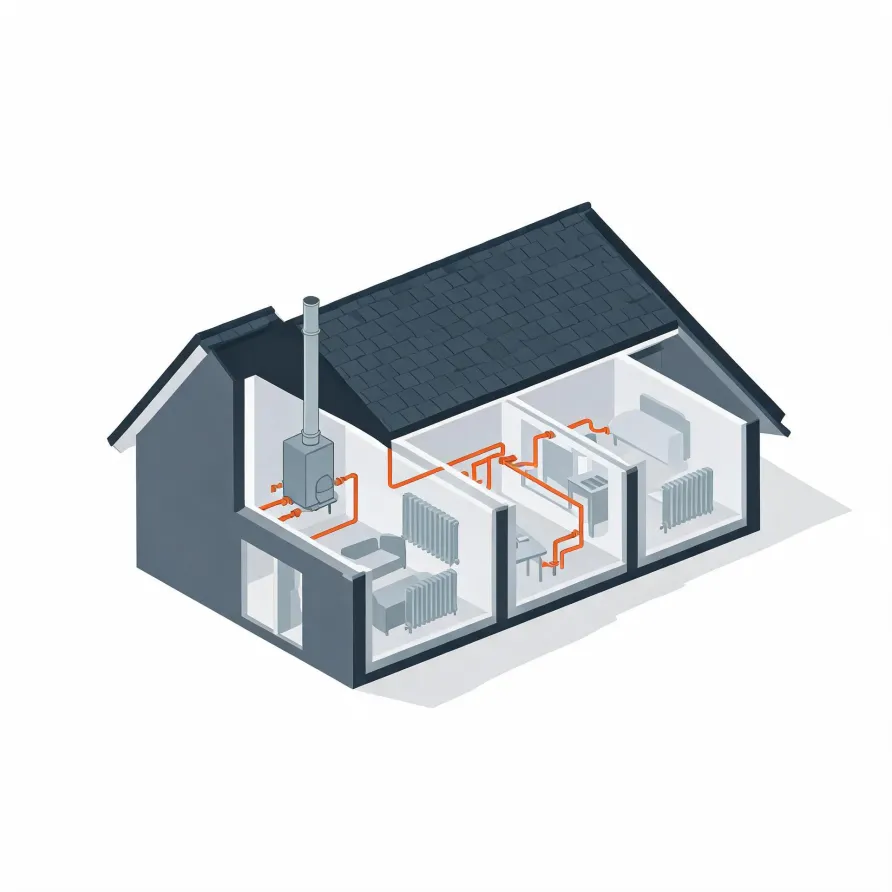
The boiler itself sits in the basement or mechanical room and is the piece a contractor goes to first. It heats water and sends it through the system. A failed heat exchanger, a faulty burner, or a bad gas valve each shows up here, and each produces a different set of symptoms.
Circulator pumps move the heated water out to the radiators or baseboard units in the living spaces, and expansion tanks sit nearby to absorb pressure changes as the water heats and cools. A contractor checks the circulator for seized bearings and the expansion tank for waterlogging, since either one can stop the system cold.
The drawing shows a typical layout, and a licensed contractor determines which components apply to your specific house and system.
Find a contractor in Halifax CountyHalifax County, by the numbers
107 severe weather events were recorded in Halifax County, North Carolina between 2015 and 2024.
NOAA National Centers for Environmental Information, Storm Events Database, bulk CSV export, events 2015-01-01 through 2024-12-31.Half the homes in Halifax County, North Carolina were built in 1979 or earlier (2020-2024 ACS 5-year).
U.S. Census Bureau, 2020-2024 American Community Survey 5-Year EstimatesHalifax County, North Carolina holds 24,872 housing units (2020-2024 ACS 5-year).
U.S. Census Bureau, 2020-2024 American Community Survey 5-Year EstimatesOwners occupy 62.9% of the occupied homes in Halifax County, North Carolina (2020-2024 ACS 5-year).
U.S. Census Bureau, 2020-2024 American Community Survey 5-Year EstimatesBoiler Repair Rules and Standards for Halifax County, North Carolina2 codes, laws, and standards
Licensing Rules for HVAC Repair in Halifax County, North Carolina
North Carolina issues Class I heating licenses covering all systems in all structures, and Class II licenses covering heating systems in single-family detached residential dwellings.
North Carolina requires a license before any person or firm may engage in, or offer to engage in, the business of heating contracting.
Severe Weather Events in Halifax County
Weather puts real hours on boiler components. When conditions swing hard, equipment works harder and wears faster, which means repair needs in Halifax County are shaped by local weather patterns as much as by age or use.
107 severe weather events, 2015–2024. Source: NOAA National Centers for Environmental Information, Storm Events Database.