Tell us about the job
Takes about a minute. No obligation.
A boiler repair quote in Lee County starts with the system's service record, because that is where the real answers sit. 71 severe weather events were recorded in Lee County, North Carolina between 2015 and 2024. At that rate, severe weather lands here as an event rather than a condition, which means the pressure relief valve that failed or the heat exchanger that cracked almost certainly got there through years of deferred maintenance or original installation quality, not through storm punishment. A contractor will check sediment buildup, burner condition, and the state of seals and fittings before drawing any other conclusion.
Boilers in houses this old often outlast their parts. Half the homes in Lee County, North Carolina were built in 1988 or earlier (2020-2024 ACS 5-year). When a contractor opens a system here, the diagnostic question settles fast; what takes time is tracing whether the valve, heat exchanger gasket, or ignition assembly the unit needs is still being made. If the part has gone out of production, the repair becomes a replacement conversation, and that has nothing to do with how the boiler was maintained or how the house was built. Stock of this age produces that situation more than newer stock does, and a quote that does not account for parts availability is missing the variable that most often changes the job.
The Parts of a Boiler a Contractor Checks First
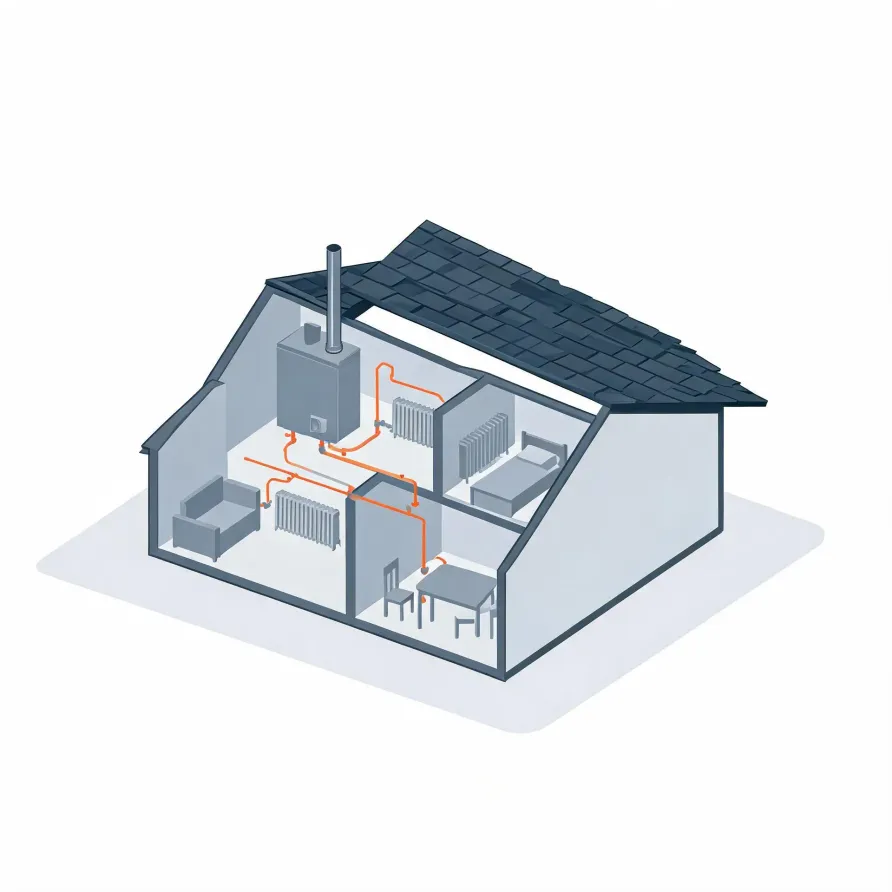
The boiler itself sits in the basement or a mechanical room and is the piece a contractor goes to first. It heats water and pushes it out through the system. When a boiler is the problem, signs tend to be hard to miss: no heat, strange sounds from the unit, or water pooling beneath it.
From the boiler, pipes carry hot water to radiators or baseboard convectors in each room, and a circulator pump keeps that water moving. The expansion tank, usually mounted near the boiler, manages pressure as the water heats and cools. A failed pump or a waterlogged expansion tank can kill heat to the whole house even when the boiler itself is fine.
The drawing shows a typical boiler layout, and a licensed contractor determines exactly which components apply to your home and its setup.
Find a contractor in Lee CountyLee County, NC, by the numbers
71 severe weather events were recorded in Lee County, North Carolina between 2015 and 2024.
NOAA National Centers for Environmental Information, Storm Events Database, bulk CSV export, events 2015-01-01 through 2024-12-31.Half the homes in Lee County, North Carolina were built in 1988 or earlier (2020-2024 ACS 5-year).
U.S. Census Bureau, 2020-2024 American Community Survey 5-Year EstimatesLee County, North Carolina holds 27,166 housing units (2020-2024 ACS 5-year).
U.S. Census Bureau, 2020-2024 American Community Survey 5-Year EstimatesOwners occupy 67.3% of the occupied homes in Lee County, North Carolina (2020-2024 ACS 5-year).
U.S. Census Bureau, 2020-2024 American Community Survey 5-Year EstimatesCodes & Standards Behind Boiler Repair in Lee County, North Carolina2 sourced rules and standards
Licensing Rules for HVAC Repair in Lee County, North Carolina
North Carolina issues Class I heating licenses covering all systems in all structures, and Class II licenses covering heating systems in single-family detached residential dwellings.
North Carolina requires a license before any person or firm may engage in, or offer to engage in, the business of heating contracting.
Severe Weather Events in Lee County
Weather puts direct stress on heating equipment: temperature swings, power interruptions, and moisture all shorten the working life of a boiler. Repair demand in Lee County follows what the weather does, which is why local conditions are part of understanding the service.
71 severe weather events, 2015–2024. Source: NOAA National Centers for Environmental Information, Storm Events Database.