Tell us about the job
Takes about a minute. No obligation.
A contractor quoting a boiler repair in Wilson County has to work out what actually drove the failure before they can say what the fix costs. 109 severe weather events were recorded in Wilson County, North Carolina between 2015 and 2024. That puts this area near the middle of counties nationally, which means the weather load is real but not so heavy that it overrides age and maintenance as the likeliest culprits when something goes wrong. A cracked heat exchanger or a seized circulator pump usually traces back to how old the system is and how consistently it was serviced, not to storm frequency. The contractor checks both before writing a scope.
Boilers in Wilson County's older homes have been swapped, patched, and replaced across enough ownership cycles that the unit running today is rarely the original one, and the parts it requires may already be at the edge of manufacturer support. Half the homes in Wilson County, North Carolina were built in 1986 or earlier (2020-2024 ACS 5-year). That gap between the building and whatever heating system ended up in it is where a repair job gets complicated: a contractor opening a boiler here has to identify exactly what generation of components the unit uses before a parts quote has any meaning, because discontinued parts push a repair toward a sourcing problem that changes the scope and the bill.
The Parts of a Boiler a Contractor Checks First
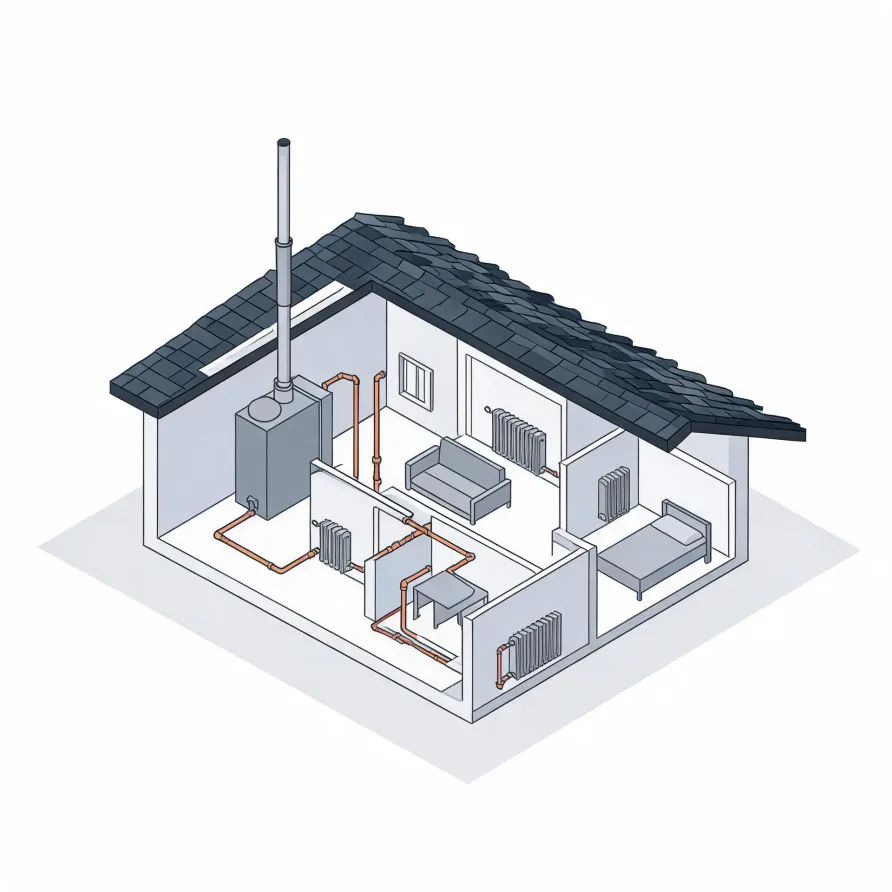
The boiler itself sits in the basement or mechanical room and is the piece a contractor looks at first. It heats water and pushes it through the system. When heat is absent or uneven, the burner assembly, heat exchanger, or pressure relief valve inside the unit is usually where the fault lives.
Radiators or baseboard convectors sit in each room and release heat from the circulating water. The circulator pump moves that water through the pipes connecting everything. A failed pump, a stuck zone valve, or a waterlogged expansion tank can each stop heat from reaching part of the house while the boiler itself runs fine.
The drawing shows the general layout of a boiler system, and a licensed contractor determines which components apply and what condition they are in for this particular house.
Find a contractor in Wilson CountyWilson County, by the numbers
109 severe weather events were recorded in Wilson County, North Carolina between 2015 and 2024.
NOAA National Centers for Environmental Information, Storm Events Database, bulk CSV export, events 2015-01-01 through 2024-12-31.Half the homes in Wilson County, North Carolina were built in 1986 or earlier (2020-2024 ACS 5-year).
U.S. Census Bureau, 2020-2024 American Community Survey 5-Year EstimatesWilson County, North Carolina holds 37,053 housing units (2020-2024 ACS 5-year).
U.S. Census Bureau, 2020-2024 American Community Survey 5-Year EstimatesOwners occupy 60.0% of the occupied homes in Wilson County, North Carolina (2020-2024 ACS 5-year).
U.S. Census Bureau, 2020-2024 American Community Survey 5-Year EstimatesCodes & Standards Behind Boiler Repair in Wilson County, North Carolina2 sourced rules and standards
Licensing Rules for HVAC Repair in Wilson County, North Carolina
North Carolina issues Class I heating licenses covering all systems in all structures, and Class II licenses covering heating systems in single-family detached residential dwellings.
North Carolina requires a license before any person or firm may engage in, or offer to engage in, the business of heating contracting.
Severe Weather Events in Wilson County
Extreme weather puts real stress on boiler systems, from pressure fluctuations during hard freezes to the strain of repeated demand spikes when temperatures swing fast. How often that kind of weather arrives in Wilson County shapes how hard local boilers have to work and how soon repairs become necessary.
109 severe weather events, 2015–2024. Source: NOAA National Centers for Environmental Information, Storm Events Database.