Tell us about the job
Takes about a minute. No obligation.
A boiler repair in Swain County starts with what the system has been through on the inside, not what the sky has done outside. 40 severe weather events were recorded in Swain County, North Carolina between 2015 and 2024. At that rate, severe weather is an event here rather than a constant, which means a failed heat exchanger or a broken zone valve is far more likely to trace back to years of use or skipped servicing than to storm load. A contractor will pull the service history, check wear on the components that go first with age, and work from there.
Boiler systems in housing stock this old have already been replaced at least once since the house was built, which means the building itself is rarely what complicates a repair call. Half the homes in Swain County, North Carolina were built in 1989 or earlier (2020-2024 ACS 5-year). What a contractor finds once the boiler is open is the question that decides how the job goes: whether the heat exchanger has cracked sections, whether zone valves have seized, whether the circulator is pulling enough pressure. Parts availability for equipment generations back is the real variable, and that is what determines whether a repair closes in one visit or stretches into sourcing.
The Parts of a Boiler a Contractor Checks First
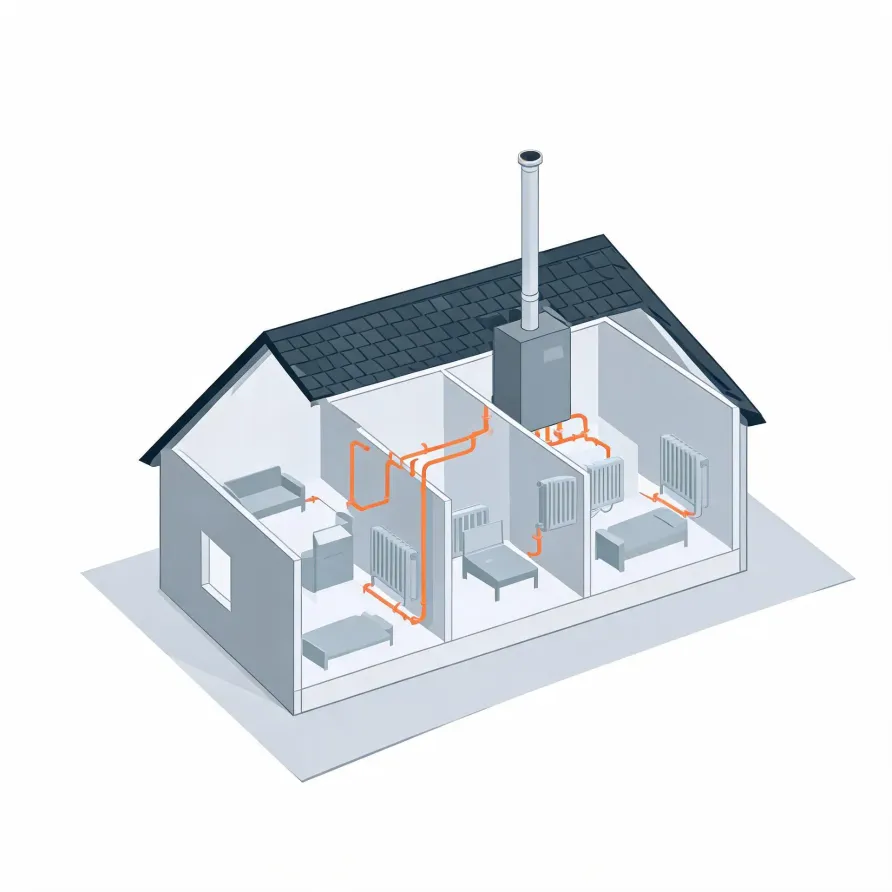
The boiler itself sits in a mechanical room, basement, or utility closet and is the piece a contractor goes to first. It heats water and pushes it through the system. When it fails, the signs range from no heat at all to uneven heat, strange sounds from the unit, or a pressure gauge sitting outside its normal range.
Radiators or baseboard units sit in the living spaces and release heat into each room. The circulator pump, which moves hot water through the pipes, and the expansion tank, which absorbs pressure changes in the water, both live near the boiler. A contractor will also check the zone valves and aquastat, which control where and at what temperature water flows.
The drawing shows a general layout of a boiler system, and a licensed contractor determines what applies to the specific equipment and configuration in your home.
Find a contractor in Swain CountySwain County, by the numbers
40 severe weather events were recorded in Swain County, North Carolina between 2015 and 2024.
NOAA National Centers for Environmental Information, Storm Events Database, bulk CSV export, events 2015-01-01 through 2024-12-31.Half the homes in Swain County, North Carolina were built in 1989 or earlier (2020-2024 ACS 5-year).
U.S. Census Bureau, 2020-2024 American Community Survey 5-Year EstimatesSwain County, North Carolina holds 8,629 housing units (2020-2024 ACS 5-year).
U.S. Census Bureau, 2020-2024 American Community Survey 5-Year EstimatesOwners occupy 72.7% of the occupied homes in Swain County, North Carolina (2020-2024 ACS 5-year).
U.S. Census Bureau, 2020-2024 American Community Survey 5-Year EstimatesBoiler Repair Rules and Codes for Swain County, North Carolina2 sourced rules and standards
Licensing Rules for HVAC Repair in Swain County, North Carolina
North Carolina issues Class I heating licenses covering all systems in all structures, and Class II licenses covering heating systems in single-family detached residential dwellings.
North Carolina requires a license before any person or firm may engage in, or offer to engage in, the business of heating contracting.
Severe Weather Events in Swain County
Swain County's climate puts real load on boiler systems, and weather extremes are a direct driver of wear, breakdowns, and repair calls. Knowing what the weather record looks like here is part of understanding why local boiler service follows the patterns it does.
40 severe weather events, 2015–2024. Source: NOAA National Centers for Environmental Information, Storm Events Database.