Tell us about the job
Takes about a minute. No obligation.
A boiler repair in this area starts with what the system has already been running against. 117 severe weather events were recorded in Ashe County, North Carolina between 2015 and 2024. At that rate, severe weather is a standing feature of operating here, and contractors who work these repairs know it. Heat exchangers, pressure relief valves, and seals take the first sustained look because those are the components that carry the load when conditions push hard. Age and installation quality stay on the list, but the weather record in this county gives a contractor a reason to start somewhere specific.
Older boilers hide their real repair cost until a contractor gets the unit open and starts tracing what it actually needs. Half the homes in Ashe County, North Carolina were built in 1983 or earlier (2020-2024 ACS 5-year). A system installed in a house built around that period has likely been through at least one set of components already, and the question a contractor has to answer is whether the specific parts a given unit takes are still in production. If they are not, a repair quote becomes a different conversation than it started as.
The Parts of a Boiler a Contractor Checks First
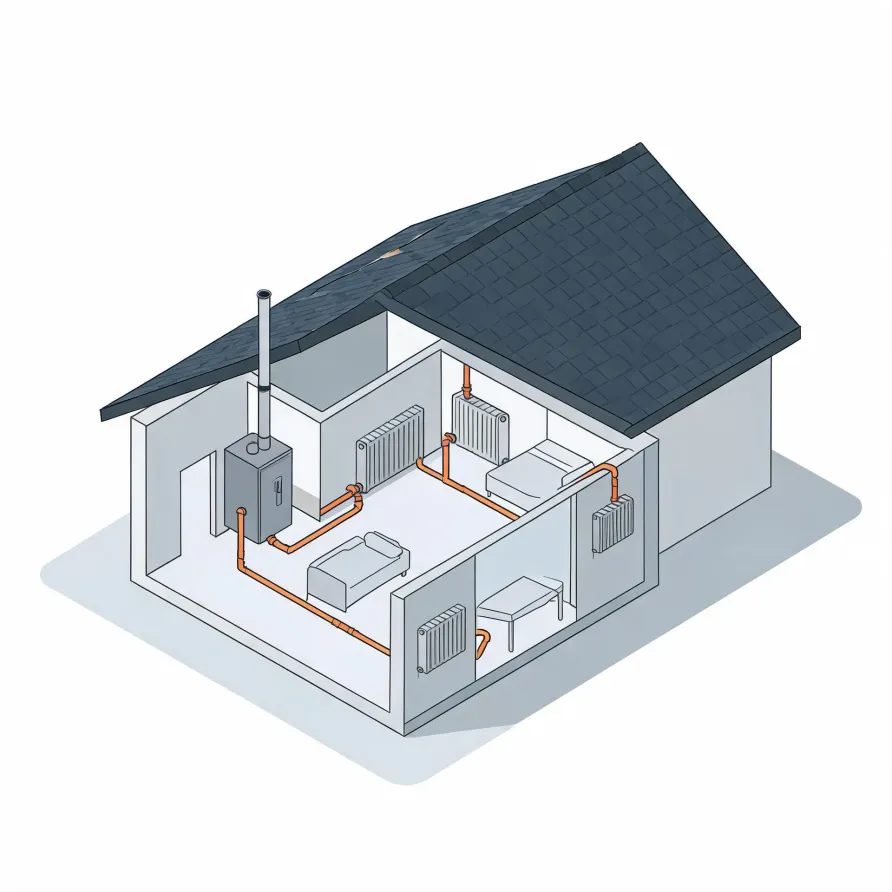
The boiler itself sits in a mechanical room, basement, or utility closet and is the unit that heats water for the whole system. When it fails, the cause is often the burner, the heat exchanger, or the pressure relief valve, each of which a contractor will examine before moving further into the system.
Circulator pumps push heated water out through the supply pipes and pull cooled water back through the return lines. The expansion tank, usually mounted near the boiler, absorbs pressure changes as water heats up, and the zone valves or thermostatic radiator valves at each radiator or baseboard unit control where heat goes.
The drawing shows a representative layout, and a licensed contractor determines which components apply to your specific setup.
Find a contractor in Ashe CountyAshe County, by the numbers
117 severe weather events were recorded in Ashe County, North Carolina between 2015 and 2024.
NOAA National Centers for Environmental Information, Storm Events Database, bulk CSV export, events 2015-01-01 through 2024-12-31.Half the homes in Ashe County, North Carolina were built in 1983 or earlier (2020-2024 ACS 5-year).
U.S. Census Bureau, 2020-2024 American Community Survey 5-Year EstimatesAshe County, North Carolina holds 17,218 housing units (2020-2024 ACS 5-year).
U.S. Census Bureau, 2020-2024 American Community Survey 5-Year EstimatesOwners occupy 79.4% of the occupied homes in Ashe County, North Carolina (2020-2024 ACS 5-year).
U.S. Census Bureau, 2020-2024 American Community Survey 5-Year EstimatesBoiler Repair Rules That Apply in Ashe County, North Carolina2 codes & standards
What the Law Requires for HVAC Repair in Ashe County, North Carolina
North Carolina issues Class I heating licenses covering all systems in all structures, and Class II licenses covering heating systems in single-family detached residential dwellings.
North Carolina requires a license before any person or firm may engage in, or offer to engage in, the business of heating contracting.
Severe Weather Events in Ashe County
Boilers work hardest when outdoor conditions swing hard, and those swings add up over time as wear on heat exchangers, pressure relief valves, and controls. How often Ashe County sees severe weather is part of understanding what the equipment here goes through.
117 severe weather events, 2015–2024. Source: NOAA National Centers for Environmental Information, Storm Events Database.