Tell us about the job
Takes about a minute. No obligation.
A contractor called out to repair a boiler in Wilkes County has to establish what the system has been running against before they can say what failed and why. 194 severe weather events were recorded in Wilkes County, North Carolina between 2015 and 2024. At that rate, weather-related stress on heat exchangers, pressure relief components, and seals is a realistic finding, and a contractor will check those parts before concluding the problem is purely one of age or original installation quality. That sequence changes what gets quoted and what gets replaced.
Boiler systems in houses this old have typically been swapped or patched more than once, and each cycle leaves a different vintage of equipment behind the utility room door. Half the homes in Wilkes County, North Carolina were built in 1980 or earlier (2020-2024 ACS 5-year). That history matters at the repair stage because a contractor who opens a unit here cannot assume the parts it needs are still in production. A heat exchanger or zone valve for a system installed two owners ago may require sourcing from specialty suppliers, and that changes both the timeline and what a contractor quotes before touching anything.
The Parts of a Boiler a Contractor Checks First
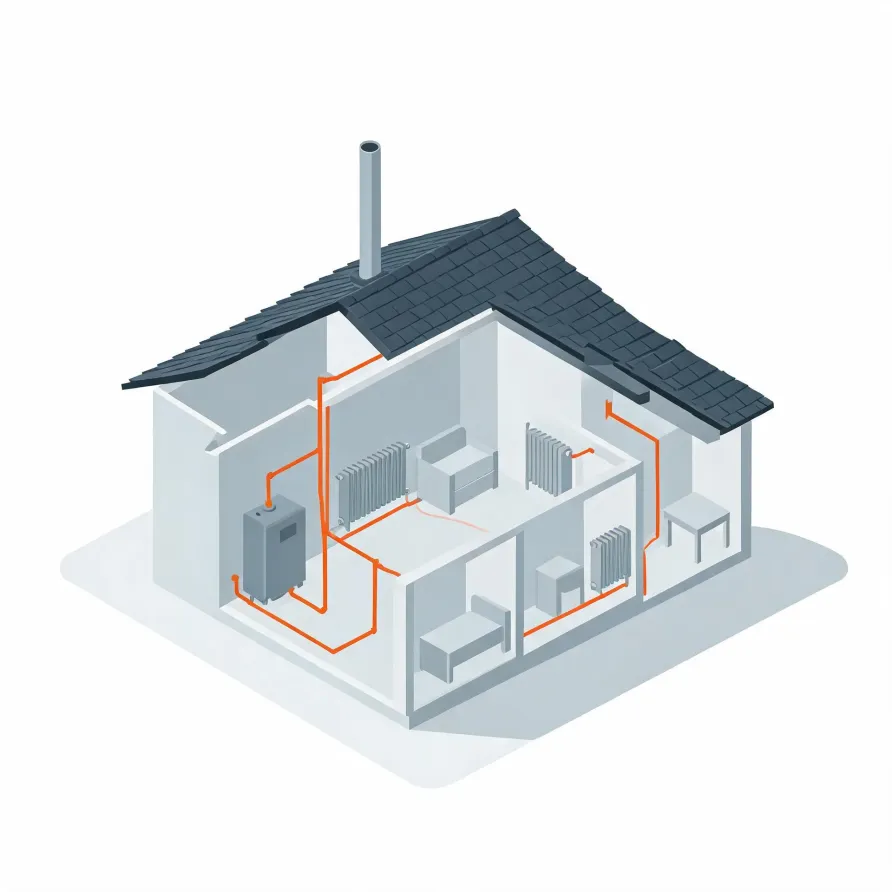
The boiler itself sits in a mechanical room, basement, or utility closet and is the piece a contractor goes to first. It heats water and pushes it through the system. When it fails, the signs range from no heat at all to uneven heat to strange noises coming from the unit itself.
Circulator pumps move the heated water through the pipes to radiators, baseboard units, or radiant floor loops distributed through the living space. The expansion tank, pressure relief valve, and zone valves sit close to the boiler and each one controls a specific condition. Any of them can be the source of a pressure problem, a leak, or a zone that stops responding.
The drawing shows a typical boiler layout, and a licensed contractor determines which components apply to your specific system.
Find a contractor in Wilkes CountyWilkes County, by the numbers
194 severe weather events were recorded in Wilkes County, North Carolina between 2015 and 2024.
NOAA National Centers for Environmental Information, Storm Events Database, bulk CSV export, events 2015-01-01 through 2024-12-31.Half the homes in Wilkes County, North Carolina were built in 1980 or earlier (2020-2024 ACS 5-year).
U.S. Census Bureau, 2020-2024 American Community Survey 5-Year EstimatesWilkes County, North Carolina holds 31,836 housing units (2020-2024 ACS 5-year).
U.S. Census Bureau, 2020-2024 American Community Survey 5-Year EstimatesOwners occupy 73.5% of the occupied homes in Wilkes County, North Carolina (2020-2024 ACS 5-year).
U.S. Census Bureau, 2020-2024 American Community Survey 5-Year EstimatesBoiler Repair Rules & Standards for Wilkes County, North Carolina2 sourced regulations and codes
What Wilkes County and North Carolina Require for HVAC Repair
North Carolina issues Class I heating licenses covering all systems in all structures, and Class II licenses covering heating systems in single-family detached residential dwellings.
North Carolina requires a license before any person or firm may engage in, or offer to engage in, the business of heating contracting.
Severe Weather Events in Wilkes County by Year
Weather puts hours on heating equipment. Every hard cold snap or storm cycle that moves through Wilkes County drives boilers harder, and that workload shows up eventually as wear, faults, or breakdowns that need a licensed contractor to fix.
194 severe weather events, 2015–2024. Source: NOAA National Centers for Environmental Information, Storm Events Database.